Debt collection letter software: Regulation F notices, and when you need CCM
For most collection agencies, the best debt collection letter software is the letter module in your collections system, as long as it builds the Regulation F validation notice from account data and keeps a copy of every send. Add a CCM platform when many clients, states, languages and channels make letter changes slow: Messagepoint for frequent wording changes, Quadient Inspire or OpenText Exstream for bank-scale batches, and CSG if you want print and mail run for you.
Shopping for debt collection letter software? Start with the validation notice. Regulation F fixes what it says, how its numbers are worked out and when the consumer’s dispute window closes. Get the data wrong and every letter in the batch is wrong.
Most agencies can produce that notice from their collections system. Banks, card issuers and servicers with many portfolios, states and channels often need a customer communications management (CCM) platform on top. This guide shows where the line sits, what the rules ask of your templates, and which platforms have public collections proof. It isn’t legal advice. For the full vendor list, see our CCM software guide.
Pick by your situation
Short on time? Start here.
- Collection agency with a handful of letter series per client? Your collections system’s letters are probably enough.
- Bank or servicer whose default and collections letters change all the time? Look at Messagepoint.
- Card issuer or bank running collections letters next to statements? Look at Quadient Inspire or OpenText Exstream.
- Want letters, print and mail handled as a service? Look at CSG.
- Healthcare billing and collections? Look at Nordis, and read our patient statements guide.
- Running SmartCOMM? Jump to renewal and exit terms.
Who Regulation F covers, and what applies if it doesn’t
Regulation F (12 CFR 1006) has applied since November 30, 2021. It covers debt collectors as the FDCPA defines them, which usually means third parties. First-party collections still have rules, just different ones.
| Who sends the letter | Regulation F? | What else to check |
|---|---|---|
| Third-party collection agency | Yes | State laws. In New York, 23 NYCRR 1 applies to third-party collectors, not original creditors. |
| Bank, card issuer or lender collecting in its own name | Generally no (1006.2(i)) | The federal ban on unfair, deceptive or abusive practices (CFPB Bulletin 2013-07). California’s Rosenthal Act covers anyone who regularly collects, including on their own behalf. |
| Creditor collecting under a name that suggests a third party | Yes (1006.2(i)(1)) | Everything in this guide. |
For first-party letters, the CFPB’s 2013 bulletin lists what gets creditors in trouble: misstating the amount or status of a debt, implying a lawyer or the government is involved, and misrepresenting what gets reported to credit bureaus. Those are data and wording controls your templates have to enforce.
What the validation notice has to say
The notice goes out in the first communication or within five days of it (1006.34(a)). Each block either pulls account data, computes a date or holds wording you can’t change. Here’s what each block needs from your platform.
Order follows Model Form B-1. The right-hand column is what to ask a vendor to prove on your own data.
-
1Header and debt collector disclosure
- Debt collector name and the mailing address where it accepts disputes
- Consumer name and mailing address
- Statement that the collector is trying to collect a debt
Fixed wording or layout
Data Collector, client and consumer records.
Platform Lock the disclosure wording and print the consumer’s current address of record.
1006.34(c)(1), (c)(2)(i) and (ii); 1006.18(e)
-
2The debt
- Original creditor on the itemization date (consumer financial products)
- Current creditor
- Account number, which can be truncated
Calculated from account data
Data Placement file from the creditor or debt buyer.
Platform Map creditor names per portfolio and mask account numbers consistently.
1006.34(c)(2)(iii) to (v)
-
3Itemization table
- Itemization date: last statement, charge-off, last payment, transaction or judgment date
- Amount owed on that date
- Interest, fees, payments and credits since then
- Amount owed now
Calculated from account data
Data Balance history from the itemization date forward.
Platform Store the chosen itemization date per debt and reuse it on every later notice. Reject a letter whose rows don’t add up to the current amount.
1006.34(b)(3), (c)(2)(vi) to (ix)
-
4Your rights and the deadlines
- Date to dispute or request the original creditor
- Statement on what happens if the consumer doesn’t dispute
- CFPB website reference (consumer financial products)
- How to dispute electronically, if the notice is sent that way
Calculated from account data
Data Send date, channel and the holiday calendar.
Platform Compute the end of the validation period from the send date and print it as a date, not a number of days.
1006.34(b)(5), (c)(3)
-
5Optional Spanish and contact details
- Offer of a Spanish copy
- Website and email for the collector
Conditional or optional
Data Language preference and channel data.
Platform If you offer Spanish, you must send a complete Spanish notice on request. Keep a Spanish template that matches the English one.
1006.34(d)(3)(v) and (vi), (e)
-
6How do you want to respond?
- “Check all that apply” dispute prompts
- Prompt to request the original creditor
- Mailing address for the response
Fixed wording or layout
Data Collector mailing address; dispute options.
Platform Keep this section separate and at the bottom, and for email or web versions, offer fillable prompts that feed your dispute queue.
1006.34(c)(4), (d)(4)
Source: CFPB, 12 CFR 1006.34 and its commentary, checked November 12, 2026. Mortgage debts with a Regulation Z periodic statement can omit some itemization fields if the statement is enclosed (1006.34(c)(5)). Schematic only; not a compliant template.
The itemization table is where letters go wrong. In a 2022 survey of consumer advocates, NCLC heard of itemization dates nobody could explain, fees without labels and doubts over whether payments had been credited. Those are data faults, and your platform should catch them before the batch runs.
Model Form B-1 is a safe harbor, not a requirement
Use Model Form B-1 from Appendix B and you meet the notice’s content and format rules (1006.34(d)(2)). Using it also protects you against claims that later messages overshadowed the consumer’s rights during the validation period (1006.38(b)). A custom design has to prove all of that itself.
So the useful question for a vendor is narrow: can it reproduce Model Form B-1 exactly from your data, in print, PDF and email body? The CFPB published a Spanish translation in October 2021. A collector that uses it, and has also sent the English model notice, keeps the safe harbor.
The validation clock, and what pauses collection
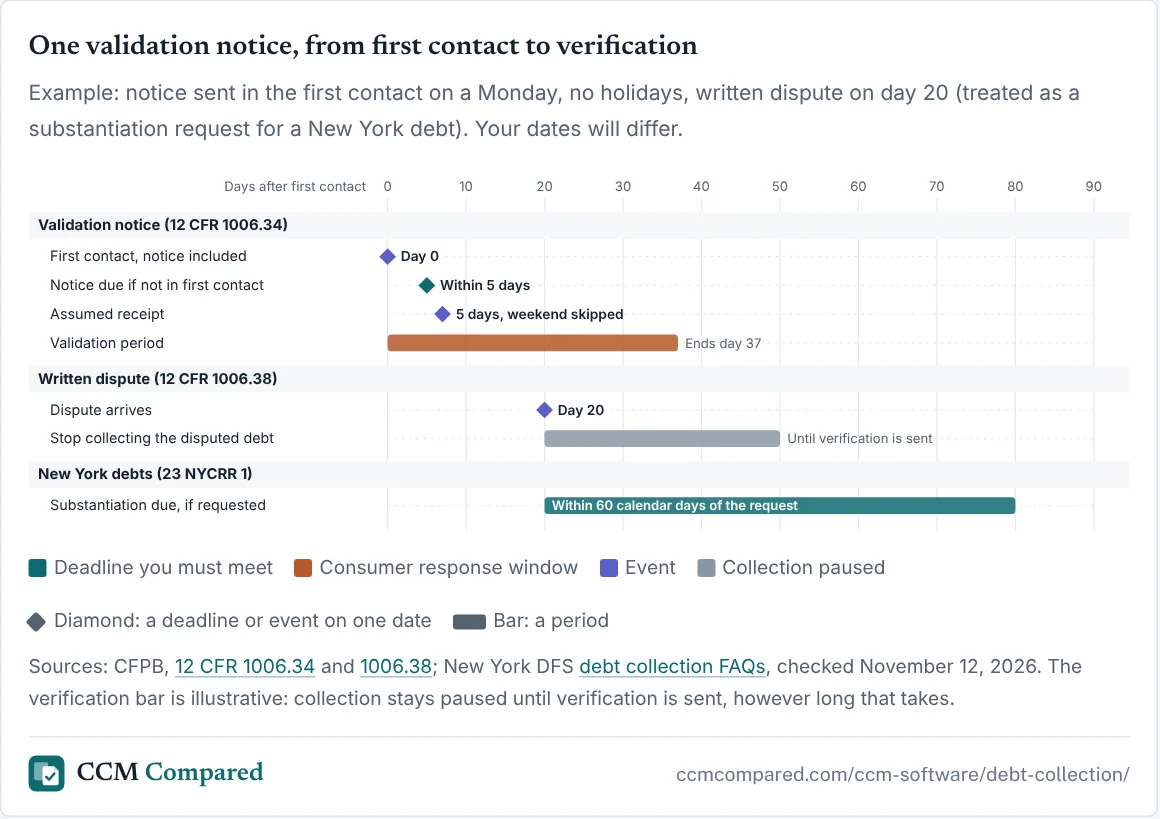
The consumer’s window to dispute closes 30 days after they receive the notice, or are assumed to. You can assume receipt any date at least five days after sending, not counting weekends and federal holidays. Here’s how that plays out for a notice mailed on a Monday.
Example: notice sent in the first contact on a Monday, no holidays, written dispute on day 20 (treated as a substantiation request for a New York debt). Your dates will differ.
Sources: CFPB, 12 CFR 1006.34 and 1006.38; New York DFS debt collection FAQs, checked November 12, 2026. The verification bar is illustrative: collection stays paused until verification is sent, however long that takes.
Two consequences for your platform. It has to compute the date printed on the notice from the actual send date. And a dispute has to stop the next letter in the series automatically, not when someone remembers to.
Email, text and opt-outs
Regulation F lets you send the validation notice electronically. It has to go out in a way “reasonably expected to provide actual notice”, in a form the consumer can keep (1006.42(a)). A notice sent electronically after the first contact must also follow the E-SIGN Act’s consent rules (1006.42(b)).
Delivery evidence matters more than the template here:
- Bounces count against you. A notice that comes back undeliverable wasn’t sent in a way expected to give actual notice. Your platform has to watch for bounces and fall back to mail.
- Recognizable senders help. The commentary points to a subject line with the creditor’s name and one identifier other than the amount.
- Every email and text needs an opt-out. A clear, simple method, such as “Reply STOP”, with no fee and no extra information asked (1006.6(e)).
- An opt-out blocks that address for disclosures too. Once a consumer opts out of an email address, you can’t use it to send required notices.
- Send times still apply. Before 8 a.m. or after 9 p.m. in the consumer’s time zone is presumed inconvenient, judged by when you send (1006.6(b)(1)).
Emails and texts don’t count toward the seven-calls-in-seven-days presumption (1006.14(b)). They’re still judged with your calls under the general ban on harassment, so your letter and messaging cadence belongs in the same contact history.
In practice, NCLC’s 2022 survey found advocates reporting notices in email bodies, attachments and links, and consumers wary of opening messages from senders they didn’t know. Test what lands, not just what sends.
Time-barred debt and state notices
Regulation F bans suing or threatening to sue on time-barred debt (1006.26(b)). The CFPB proposed a federal disclosure for these debts, then dropped it in the final rule. States filled the gap, so your template rules need the consumer’s state and the debt’s age.
| Where | What the letter needs | Rule |
|---|---|---|
| California | Set wording that you won’t sue, and whether you’ll report the debt, in the first written notice after the debt becomes time-barred or passes the credit reporting limit | Civil Code 1788.14(d) |
| New York (third-party collectors) | Disclosure before accepting any payment on a time-barred debt, including that acknowledging or promising to pay it may restart the limitations period | 23 NYCRR 1.3 |
California’s notice has two versions, one for debts still reportable to credit bureaus and one for debts past that point. That’s a data-driven variant, not a paragraph someone pastes in.
Need adverse action notices or Regulation E and Z statement content? Our CCM software for banks guide covers them. Mortgage servicers’ delinquency notices under Regulation X are in our lending guide.
When your collections system’s letters are enough
Agency collections systems ship with letter modules. If yours produces Model Form B-1 from your data, tracks email opt-outs and keeps every sent copy, you may not need anything else. The CFPB counts copies of documents provided to consumers among the records to keep, for three years after the last collection activity (1006.100).
| You have | Usually enough | Add a CCM platform when |
|---|---|---|
| A few letter series per client, one language | Collections system letters | Rarely. |
| Many clients, each with its own branding and disclosures | Collections system, if it supports client-level templates | Template edits wait in an IT queue for weeks. |
| Spanish notices and state-specific variants | Collections system with conditional text | Variants multiply past what anyone can review. |
| First-party collections inside a bank or card issuer | Collections platform letters | Collections letters must match statement, servicing and marketing branding and approvals across products. |
| Print, email and text from one approved template | Collections system plus a mail vendor | You need one archive of every version sent, on every channel. |
Not sure which side you’re on? Our CCM vs document generation guide explains the difference.
Who has public collections proof
Many CCM vendors pitch collections. Few have a collections customer or product announcement on record outside their own website. Read across a row to see what’s public and how old it is.
Dates are when it was announced or reported. SmartCOMM shown for reference. As of November 12, 2026.
| Vendor | Collections or receivables customer | Email or digital notices | Business-user letter changes | Source type |
|---|---|---|---|---|
| Nordis Expresso | Meduit, a revenue cycle firm producing about 2 million billing statements and letters a month 1 | Mail, email or text, with each patient’s channel preference 1 | Meduit said a single letter change used to take two to four weeks before the move 1 | Press release |
| RevSpring | No public record found | eVoke Inbox: documents in the email body, attachments or links, for ARM organizations 2 | No public record found | Press release and trade press |
| CSG | Markets validation notice, reminder and settlement templates; names no collections clients | Email and SMS reminders linked to payment portals | Template changes without IT | Vendor pages only |
| Messagepoint | No public record found | No public record found | Borrower communications for mortgage servicers; MortgagePoint award, second year 3 | Press release |
| Quadient Inspire, OpenText Exstream | Ask for named collections references | Ask | No public record found | Vendor pages only |
| SmartCOMMreference | Integration with CGI Credit Studio, aimed partly at default management 4 | No public record found | No public record found | Trade press of a press release |
None of these records mentions Regulation F or Model Form B-1 by name. Make the validation notice the first thing every vendor builds in the demo.
The best debt collection letter software, by situation
These picks pair each option’s collections record with its review and analyst record. CCM ratings aren’t collections-specific; every number is in our CCM benchmark.
Your collections system’s letter module
Best for third-party agencies with a few letter series per client
- 4.5 ★ACE (WebAR), 140 Capterra reviews
- 4.7 ★Collect!, 70 Capterra reviews
- 4.2 ★Beyond ARM, 39 Capterra reviews
The letters live where the account data, dispute flags and contact history already sit. That’s the shortest path to a correct itemization table and an automatic hold when a dispute comes in. Ratings are from Capterra’s category page, September 2026.
Watch out: Capterra’s debt collection category mixes agency systems with receivables and CRM tools, and its listings don’t show letter detail. Ask for a Model Form B-1 built from your own placement file.
Best for banks and servicers whose default and collections letters change with every rule or portfolio
- 4.4 ★69 Gartner ratings (Oct 2026)
- LeaderIDC MarketScape 2026, per Messagepoint
In June 2026 Messagepoint announced a MortgagePoint Tech Excellence Award for its borrower communications work, the second year running. It says its MARCIEAssist AI helps servicers make updates across large sets of communications. Ask to see that on a collections letter series.
Watch out: its public financial services record is mortgage servicing, not collections. Ask for a collections reference.
Best for card issuers and banks running collections letters alongside statements on one platform
- 4.8 ★130 Gartner ratings (Oct 2026)
Strong review scores on Gartner Peer Insights, G2 and TrustRadius. Pick it if collections is one of many letter programs you want under one set of templates, approvals and archive.
Watch out: no public collections customer, so ask for one at your volume.
Best for very large nightly collections batches inside a bank
- 4.4 ★76 Gartner ratings (Oct 2026)
TrustRadius reviewers list fast batch processing and fast, reliable document generation among its strengths. That suits early-stage letters to millions of card or auto accounts, where the notice is standard and the volume is the problem.
Watch out: no public collections customer, so ask for one, and time how long a business user takes to change a letter.
CSG
Best for agencies and creditors that want letters, print and mail run as one service
- LeaderQKS SPARK Matrix CCM 2026
CSG says it offers pre-approved templates for validation notices, reminders and settlement offers, plus print and mail and email and SMS reminders. It names no collections clients. QKS named its Xponent platform a Leader in July 2026.
Watch out: its collections claims sit on its own pages, with no named clients. Ask for two collections references.
Nordis Expresso
Best for healthcare billing and collections firms that want CCM on a hosted print service
- ~2MMeduit statements and letters a month, 2021
- 850+health systems and practices Meduit served, 2021
Meduit, a revenue cycle firm, consolidated its CCM, digital delivery and print and mail with Nordis in 2021. Its CEO said a single letter change had taken two to four weeks under its previous setup.
Watch out: its public record dates from 2021, so ask for current references.
Prefer email-first notices? RevSpring announced eVoke Inbox for ARM firms in 2020, with notices in the email body, as attachments or as links. Ask how it handles 1006.42 delivery evidence today.
Running SmartCOMM for collections today?
In 2023 Smart Communications announced an integration between SmartCOMM and CGI Credit Studio, CGI’s credit management software, aimed partly at default management. If your collections letters run that way, your exit plan has to cover the integration as well as the templates.
- Find your notice date in the order form and plan back from it. Our SmartCOMM contract renewal plan has the dated steps.
- Get your records out. Copies of every notice sent, with send dates and channels, have to stay retrievable for three years after the last collection activity. Write the export into the contract.
- Export templates and rules, including itemization logic, Spanish versions and state variants.
- List every integration, such as CGI Credit Studio, and who maintains it.
- Ask for a short extension sized to a parallel run through a full validation cycle.
Then compare your options in SmartCOMM alternatives and plan the move with our guide to migrating off SmartCOMM.
What to put in your RFP
These lines come from the rules above. Untick what doesn’t apply, then copy them into our CCM RFP template.
Each line maps to a Regulation F section or state rule above. Untick lines that don’t apply.
How to test the shortlist
Use your own placement file, not the vendor’s demo data.
- Build Model Form B-1 for ten real accounts, including one with fees, one with payments and one with a judgment date.
- Mail one and email one on a Friday and check the printed dispute date on each.
- Log a dispute for a test account and show the next letter in the series stopping.
- Bounce an email and show the fallback to mail, with both events in the history.
- Score each vendor with our CCM vendor scorecard.
Get a vendor shortlist for your requirements
Answer six quick questions about your industry, systems and needs, and get a personalized shortlist of two or three platforms, with the reason for each.
The finder runs in your browser. Nothing you enter is stored or sent.
Frequently asked questions
What must a Regulation F validation notice include?
The debt collector’s and consumer’s names and addresses, the creditors, an account number, an itemization of the debt from a chosen itemization date to today, the date by which the consumer can dispute or ask for the original creditor, and a response section at the bottom (12 CFR 1006.34(c)). It also carries the statement that the collector is trying to collect a debt.
Do debt collectors have to use Model Form B-1?
No. Using Model Form B-1 from Appendix B is a safe harbor for the notice’s content and format (12 CFR 1006.34(d)(2)), and a substantially similar form also qualifies. A custom notice has to meet every requirement on its own.
Can you send a validation notice by email?
Yes, if you send it in a way reasonably expected to give actual notice, in a form the consumer can keep (12 CFR 1006.42(a)). A notice sent electronically after the first contact must follow the E-SIGN Act’s consent rules, and a bounce-back means the notice didn’t count.
Does Regulation F apply to banks collecting their own debts?
Generally not, if the bank collects in its own name. It does apply if a creditor uses another name that suggests a third party is collecting (12 CFR 1006.2(i)). Original creditors are still bound by the federal ban on unfair, deceptive or abusive practices, and some state laws, such as California’s Rosenthal Act, reach them directly.
Do collection letters need a time-barred debt disclosure?
Not under Regulation F: the CFPB dropped its proposed disclosure and instead banned suing or threatening to sue on time-barred debt. Some states require one, including California (Civil Code 1788.14(d)) and New York for debts covered by 23 NYCRR 1.
How long must a debt collector keep copies of letters?
Three years after the last collection activity on the debt (12 CFR 1006.100). Copies of documents provided to consumers are one of the CFPB’s examples of records to keep.
Charts from this guide
Free to share with a link back to this page. Tap a chart for the full-size image.
Sources
- CFPB: 12 CFR 1006.34 (Regulation F, validation information)
- eCFR: Appendix B to Part 1006, Model Form B-1
- CFPB: 12 CFR 1006.42 (sending required disclosures)
- CFPB: 12 CFR 1006.6 (communications, including the electronic opt-out notice)
- CFPB: 12 CFR 1006.14 (harassing conduct and call frequency)
- CFPB: 12 CFR 1006.18 (false or misleading representations, required disclosures)
- CFPB: 12 CFR 1006.26 (time-barred debts)
- CFPB: 12 CFR 1006.38 (disputes and original-creditor requests)
- CFPB: 12 CFR 1006.100 (record retention)
- CFPB: 12 CFR 1006.2 (definitions, debt collector)
- Federal Register: Debt Collection Practices (Regulation F) final rule, January 19, 2021
- CFPB: Debt collection compliance resources
- CFPB: Bulletin 2013-07, UDAAPs in the collection of consumer debts
- CFPB: Bulletin 2013-07 full text (PDF)
- New York DFS: Industry debt collection FAQs (23 NYCRR 1)
- California Civil Code 1788.2 (Rosenthal Act definitions)
- California Civil Code 1788.14 (time-barred debt notice)
- insideARM: CFPB releases Spanish model validation notice, October 2021
- NCLC: Evaluating Regulation F (November 2022)
- Capterra: Debt collection software category (September 2026)
- accountsrecovery.net (press release): Meduit taps Nordis Technologies, March 2021
- insideARM (press release): RevSpring introduces eVoke Inbox for ARM organizations, June 2020
- MediaPost: Firm offers a way to send collection notices by email
- QKS Group: CSG a Leader in the SPARK Matrix for CCM 2026
- Business Wire (press release): Messagepoint MortgagePoint Tech Excellence Award, June 2026
- BNN Bloomberg (press release): Messagepoint a Leader in the 2026 IDC MarketScape
- Gartner Peer Insights: Messagepoint
- Gartner Peer Insights: Quadient Inspire
- TrustRadius: OpenText Exstream reviews
- Gartner Peer Insights: OpenText Exstream
- DOCUMENT Strategy Media: Smart Communications and CGI partner on debt collections, April 2023
CCM Compared is independent and not affiliated with Smart Communications or any vendor named here. Product names are trademarks of their owners and are used to identify products only. See our methodology and disclosure. Spotted an error? Request a correction.