Health plan member onboarding software: enrollment notices, ID cards and welcome kits
Health plan member onboarding software has to hit CMS clocks: acknowledgment or request-for-information notices within 10 days of an enrollment request, confirmation within 10 days of CMS’s reply, and the ID card and Evidence of Coverage soon after. A CCM platform builds those notices and the welcome kit from enrollment data. Messagepoint and Quadient Inspire have the clearest public payer record.
Shopping for health plan member onboarding software? Start with the documents, because that’s where CMS sets the clock. Between an enrollment request and a member’s first claim, you owe an acknowledgment or a request for missing information, a confirmation, an ID card, the Evidence of Coverage and directories, each with its own deadline.
A customer communications management (CCM) platform writes those notices and assembles the welcome kit from enrollment data. This guide covers the clocks, what Star Ratings do and don’t measure, and which platforms have public payer proof. It isn’t legal advice. For annual ANOC and EOC deadlines and language notices, see our CCM for healthcare payers guide. For the full vendor list, see our CCM software guide.
Pick by your situation
Short on time? Start here.
- Medicare Advantage plan wanting a payer-built product? Look at Messagepoint.
- Many legacy letter systems to fold into one? Look at Quadient Inspire.
- Want a payer specialist and fine with a smaller review base? Look at Elixir.
- Only need the enrollment case and member data managed? That’s a workflow or CRM job, not CCM. See which layer does what.
- Running SmartCOMM? Jump to renewal and exit terms.
Three layers of member onboarding software
Search results for this topic mix three kinds of product. Most plans run all three, so know which one you’re buying.
| Layer | What it does | Typical tools |
|---|---|---|
| Enrollment workflow or CRM | Takes the application, tracks the case, sends it to CMS, stores member data | Enrollment systems, low-code workflow, CRM |
| CCM platform | Writes the acknowledgment, RFI, confirmation, ID card carrier and welcome kit from that data, in every language and format | Messagepoint, Quadient Inspire, Elixir and others below |
| Print and card fulfillment | Prints cards, binds kits, mails them, reports delivery | Your print vendor or in-house mail center |
The CCM layer is where most rule changes land. A new denial reason or ID card field is a template edit, and you want your enrollment team making it, not a developer. Our CCM vs document generation guide explains where simpler tools stop.
The CMS clocks for Medicare enrollment notices
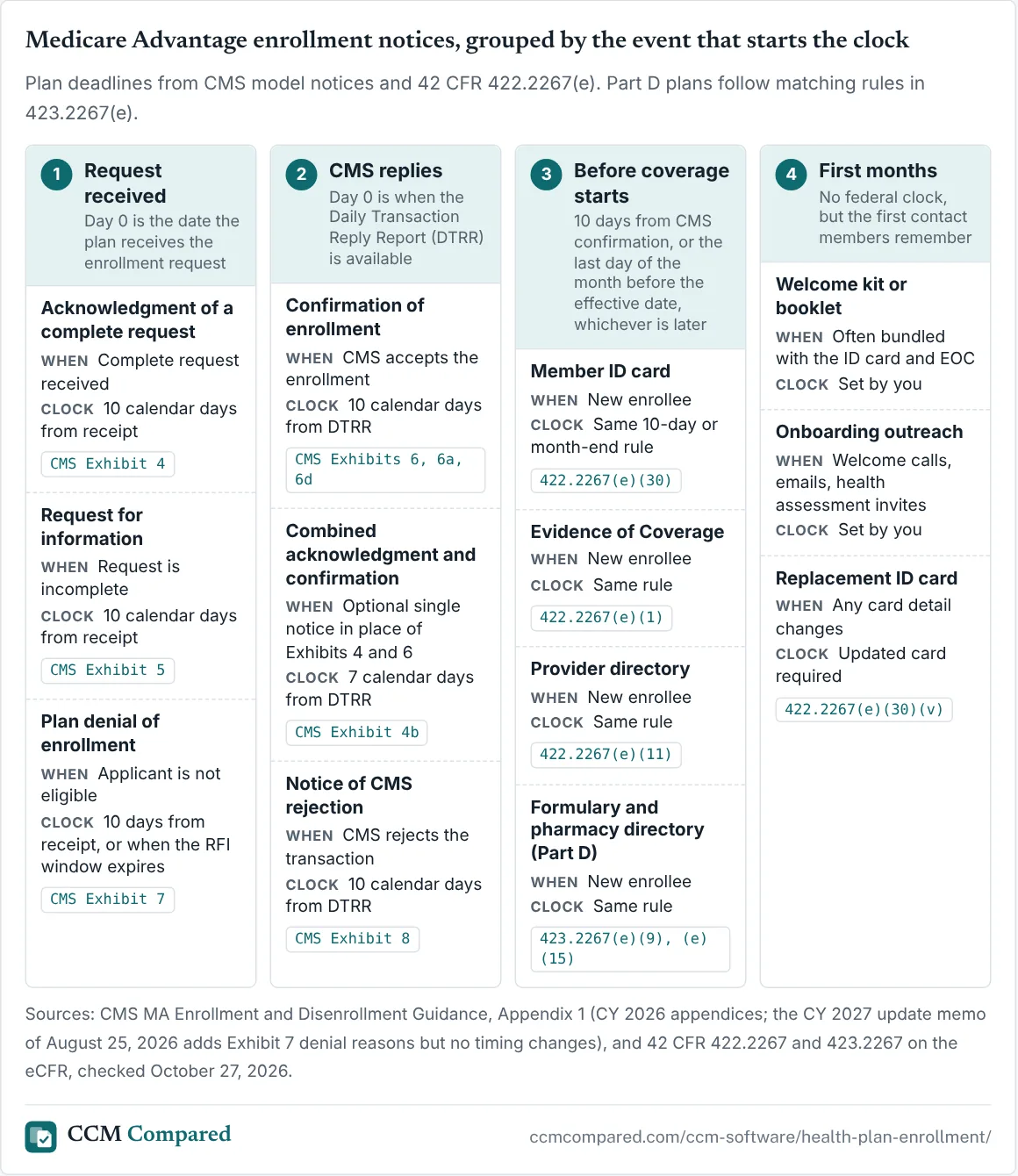
Medicare enrollment notices run on three clocks, each starting from a different event. That’s why late notices are common: teams track one date when there are three.
Plan deadlines from CMS model notices and 42 CFR 422.2267(e). Part D plans follow matching rules in 423.2267(e).
-
Request received
Day 0 is the date the plan receives the enrollment request
-
Acknowledgment of a complete request
When Complete request received
Clock 10 calendar days from receipt
CMS Exhibit 4
-
Request for information
When Request is incomplete
Clock 10 calendar days from receipt
CMS Exhibit 5
-
Plan denial of enrollment
When Applicant is not eligible
Clock 10 days from receipt, or when the RFI window expires
CMS Exhibit 7
-
-
CMS replies
Day 0 is when the Daily Transaction Reply Report (DTRR) is available
-
Confirmation of enrollment
When CMS accepts the enrollment
Clock 10 calendar days from DTRR
CMS Exhibits 6, 6a, 6d
-
Combined acknowledgment and confirmation
When Optional single notice in place of Exhibits 4 and 6
Clock 7 calendar days from DTRR
CMS Exhibit 4b
-
Notice of CMS rejection
When CMS rejects the transaction
Clock 10 calendar days from DTRR
CMS Exhibit 8
-
-
Before coverage starts
10 days from CMS confirmation, or the last day of the month before the effective date, whichever is later
-
Member ID card
When New enrollee
Clock Same 10-day or month-end rule
422.2267(e)(30)
-
Evidence of Coverage
When New enrollee
Clock Same rule
422.2267(e)(1)
-
Provider directory
When New enrollee
Clock Same rule
422.2267(e)(11)
-
Formulary and pharmacy directory (Part D)
When New enrollee
Clock Same rule
423.2267(e)(9), (e)(15)
-
-
First months
No federal clock, but the first contact members remember
-
Welcome kit or booklet
When Often bundled with the ID card and EOC
Clock Set by you
-
Onboarding outreach
When Welcome calls, emails, health assessment invites
Clock Set by you
-
Replacement ID card
When Any card detail changes
Clock Updated card required
422.2267(e)(30)(v)
-
Sources: CMS MA Enrollment and Disenrollment Guidance, Appendix 1 (CY 2026 appendices; the CY 2027 update memo of August 25, 2026 adds Exhibit 7 denial reasons but no timing changes), and 42 CFR 422.2267 and 423.2267 on the eCFR, checked October 27, 2026.
So your platform needs three date fields per member, not one: request received, DTRR available and CMS confirmation. Your enrollment system holds them. Your CCM platform has to read them and prove the send date.
What the ID card rules mean for templates
The MA ID card is a CMS model document with its own rules. It must show the plan website, customer service number and contract and plan benefit package number. PPO and PFFS cards add “Medicare limiting charges apply.” It can’t use any part of a Social Security number.
Cards are exempt from the translation and 12-point font rules, unlike most member documents. Integrated D-SNPs must issue one card that works for both the Medicare and Medicaid plan, by contract year 2027 at the latest. If you run D-SNPs, test that layout now.
Medicaid and commercial members
Medicaid managed care plans owe new enrollees a handbook “within a reasonable time” after notice of enrollment (42 CFR 438.10(g)). Electronic delivery is allowed only if members can get paper free within 5 business days, and critical materials must be in each prevalent language.
Commercial plans set their own onboarding clocks through state law and employer contracts. Ask vendors to show the same template library serving Medicare, Medicaid and commercial lines, with rules picking the right version.
What Star Ratings measure, and where onboarding fits
Plenty of vendors say better communications raise your Star Ratings. CMS doesn’t score welcome kits or enrollment letters. What it scores is how members later rate the plan, complain or leave, and onboarding is often their first real contact with you.
Here are the 2027 measures closest to that first contact, from CMS’s own measure list. The “where onboarding touches it” column is our reading, not CMS’s.
| Star measure (2027) | Part | Weight | Where onboarding touches it |
|---|---|---|---|
| Customer Service (CAHPS) | C | 2 | Whether the plan gave members the information or help they needed |
| Rating of Health Plan (CAHPS) | C | 2 | Members’ overall view of the plan |
| Getting Needed Care (CAHPS) | C | 2 | Knowing how to find in-network doctors and specialists |
| Care Coordination (CAHPS) | C | 2 | Members’ view of whether their care is joined up |
| Rating of Drug Plan, Getting Needed Prescription Drugs (CAHPS) | D | 2 each | Knowing the formulary and pharmacy network |
| Complaints about the Health or Drug Plan | C, D | 2 | Complaints caused by late cards or confusing letters |
| Members Choosing to Leave the Plan | C, D | 2 | Members who leave after a poor first year |
| Call Center: Foreign Language Interpreter and TTY Availability | C, D | 2 | The phone number printed on the ID card and in every notice |
Two CMS facts shape your timing. The CAHPS survey only goes to members enrolled six months or longer, so by the time a new member can answer it, onboarding is over and remembered. And CMS publishes the results on Medicare Plan Finder, where shoppers compare plans.
What onboarding software can honestly do is make sure every new member gets the right card, in the right language and format, on time, with the right numbers on it. That helps you avoid complaints you didn’t need to get. Anyone promising a Star increase from a template change should show you contract-level data.
What members say about onboarding
McKinsey surveyed 3,501 people in June 2021, including 636 Medicare Advantage members. Mail still carried most onboarding.
- 66% got plan, care and coverage details by mail. 15% got nothing.
- 19% were asked to complete a health assessment, and 5% were asked about social needs.
- Fewer than half were fully satisfied with access to resources (42%) or picking a primary care doctor (49%).
That points to a mailed kit built around the member’s own plan and doctors, not a generic brochure.
See which capabilities matter most to you
Tick the onboarding documents you send. The list underneath ranks capabilities by how many of your documents need them.
A dot means the document relies on that capability. Annual ANOC, EOC and EOB needs are on our healthcare payers page.
Scroll the table sideways to see every capability.
| Document and rule | Reads request, DTRR and confirmation dates | CMS model notice with controlled edits | Denial or RFI reasons passed in as data | Plan and benefit data per member | Language and accessible format rules | Kit assembly from a shared library | Card data file and carrier letter for the card vendor | Mail, email and portal from one template | Archive of the sent copy with send date |
|---|---|---|---|---|---|---|---|---|---|
| CMS Exhibit 4: 10 days from receipt | ● | ● | ● | ● | ● | ||||
| CMS Exhibit 5: 10 days from receipt | ● | ● | ● | ● | ● | ||||
| CMS Exhibit 7 | ● | ● | ● | ● | ● | ||||
| CMS Exhibits 4b, 6: 7 or 10 days from DTRR | ● | ● | ● | ● | ● | ● | |||
| 422.2267(e)(30) | ● | ● | ● | ● | |||||
| 422.2267(e)(1), (e)(11) | ● | ● | ● | ● | ● | ||||
| 438.10(g) | ● | ● | ● | ● | ● |
Rules: CMS enrollment guidance Appendix 1 and 42 CFR 422.2267, 423.2267 and 438.10, checked October 27, 2026. Capability mapping is our model of typical plan production.
Accessible output belongs on every row. Our accessible communications guide covers PDF/UA and the 2027 HHS dates.
SmartCOMM alternatives for health plans: who has enrollment proof
Most CCM vendors market to health plans. Fewer have payer enrollment or onboarding work on record outside their own website. Read across a row to see what’s public and how old it is.
Dates are when it was announced or reported. SmartCOMM shown for reference. As of October 27, 2026.
| Vendor | Enrollment and onboarding documents | Medicare Advantage focus | Named or sized payer customer | Source type |
|---|---|---|---|---|
| Messagepoint | Pre- and post-enrollment materials in Healthcare Touchpoint Exchange 1 | Says its platform handles enrollment and other communications for about 18% of MA members 2 | No public record found | Press releases |
| Quadient Inspire | PacificSource: member plan materials, renewals and member letters 3 | No public record found | Unnamed US-based top-five global health insurer, $12M+ deal 4 | Press releases |
| Elixir | No public record found | Medicare communication solutions for health plans 5 | No public record found | Trade press |
| OpenText Exstream, Adobe AEM Forms | Ask for named payer enrollment references | Ask | No public record found | Vendor pages only |
| SmartCOMMreference | Markets enrollment communications to MA plans 6 | Links communications to Star Ratings, per its blog as reported 6 | No public record found | Trade press relaying vendor blog |
No release above names an enrollment system connector or a DTRR feed. Make both a demo item, not a checkbox.
The best platforms for health plan enrollment communications
These picks pair each platform’s payer record with its review and analyst record. Ratings aren’t payer-specific; every number is in our CCM benchmark.
Best for Medicare Advantage plans that want enrollment and annual documents in one payer-built product
- 4.4 ★69 Gartner ratings, Oct 2026
- LeaderIDC MarketScape 2026
- ~18%of MA members, Messagepoint says
Its Healthcare Touchpoint Exchange covers pre- and post-enrollment materials alongside the ANOC, EOC and Summary of Benefits. That means one content library for new-member kits and the annual cycle. Ask Messagepoint for a welcome kit it has produced and the plan behind it.
Watch out: the 18% figure is Messagepoint’s own and no payer is named, so ask for two enrollment references your size.
Best for plans folding many legacy letter systems into one hub
- 4.8 ★130 Gartner ratings, Oct 2026
- LeaderQKS SPARK Matrix 2026
- 60%fewer content blocks at PacificSource
Quadient announced in 2023 that PacificSource, serving over 600,000 people in four states, replaced its legacy system with Inspire for plan materials, renewals and member letters. It cut its content blocks from nearly 20,000 to under 8,000. Separately, Quadient announced a $12 million-plus deal in 2023 for a top-five global health insurer to make Inspire its central CCM hub.
Watch out: neither release names enrollment notices or ID cards, so demo the RFI and confirmation flow on your data.
Elixir
Best for Medicare plans that want a payer specialist and will check references closely
- 3.8 ★63 Gartner ratings, Oct 2026
- Jan 2025Medicare launch
Elixir announced Medicare communication solutions for health plans in January 2025, plus its Elixir Catalyst migration tool for faster deployment. Ask which of your enrollment notices it has shipped for another plan.
Watch out: it has the lowest Gartner rating of the CCM suites in our benchmark, and the launch named no customers.
Using a forms tool for digital enrollment? Adobe AEM Forms suits applications that start as a form; see SmartIQ vs Adobe AEM Forms. You’ll still need a CCM layer for the notices.
Running SmartCOMM for enrollment today?
Smart Communications markets SmartCOMM to Medicare Advantage plans for enrollment communications and ties them to Star Ratings, as a 2023 FinTech Global piece relaying its blog shows. In 2025 it announced a majority investment from Cinven. Your renewal is the moment to set your exit terms.
- Find your notice date in the order form and plan back from it. Our SmartCOMM contract renewal plan has the dated steps.
- Get export rights in writing: templates, CMS model notice variants, shared content and the archive of sent notices, with send dates intact.
- List every feed into enrollment notices, such as DTRR dates, plan benefit data and the card vendor file, and who maintains each one.
- Ask for transition access after notice, so you can run old and new side by side through a full annual election period.
- Price a short extension sized to a migration, not a multi-year term.
Then compare options in SmartCOMM alternatives and plan the move with our guide to migrating off SmartCOMM.
What to put in your RFP
These lines map to the rules above. Add them to our CCM RFP template.
- Three date fields per member (request received, DTRR available, CMS confirmation) driving every notice clock.
- CMS model notices for Exhibits 4 to 8, with controlled edits and change history.
- RFI and denial reasons as data, never typed by hand.
- An ID card data file and carrier letter for your card vendor, with replacement cards triggered by data changes.
- Integrated D-SNP card layouts if you run D-SNPs.
- Kit assembly from a shared library, picked by plan, state and language.
- Send-date proof and an archive of each notice as sent, searchable by member ID.
- Two payer references for enrollment work you can call without the vendor on the line.
Score the answers with our CCM vendor scorecard.
Working with providers too? See patient statement software.
Get a vendor shortlist for your requirements
Tell us what you run today and what you need, and we’ll suggest the two or three platforms that fit, and why.
We reply through LinkedIn and only share your details with a vendor if you ask us to.
Frequently asked questions
When must a Medicare Advantage plan send the member ID card?
Within 10 calendar days of receiving CMS confirmation of enrollment, or by the last day of the month before coverage starts, whichever is later (42 CFR 422.2267(e)(30)). Part D plans follow the same rule under 423.2267(e)(32).
What is a request for information notice in Medicare enrollment?
The notice a plan sends when an enrollment request is incomplete, asking the applicant for what’s missing. CMS’s enrollment guidance sets it at 10 calendar days from receipt of the request, using its model Exhibit 5.
Do welcome kits improve Medicare Star Ratings?
No Star Ratings measure scores a welcome kit. CMS does score member survey results, complaints and members choosing to leave the plan, and onboarding is often a member’s first contact with the plan behind those scores.
Can a plan send one notice instead of an acknowledgment and a confirmation?
Yes. CMS allows a combined acknowledgment and confirmation notice, sent within 7 calendar days of the Daily Transaction Reply Report (DTRR) being available. If you send it, you skip the separate acknowledgment.
Is member onboarding software the same as a CCM platform?
Not always. Workflow and CRM tools handle the enrollment case and data. A CCM platform writes the letters, cards and kits. A print or card vendor produces and mails them. Most plans need all three.
Charts from this guide
Free to share with a link back to this page. Tap a chart for the full-size image.
Sources
- eCFR: 42 CFR 422.2267 (MA required materials and content)
- eCFR: 42 CFR 423.2267 (Part D required materials and content)
- eCFR: 42 CFR 422.60 (election process)
- eCFR: 42 CFR 438.10 (Medicaid managed care information requirements)
- CMS: Medicare Advantage enrollment and disenrollment guidance, appendices and exhibits (CY 2026)
- CMS: Parts C and D enrollment and disenrollment guidance (CY 2027)
- CMS: HPMS memo on CY 2027 enrollment and disenrollment guidance, August 25, 2026
- CMS: 2027 Star Ratings measures and weights
- CMS: 2027 Medicare Advantage and Part D Star Ratings fact sheet, October 8, 2026
- CMS: Medicare Advantage and Prescription Drug Plan CAHPS survey
- McKinsey: What Medicare Advantage members want from their onboarding experience, April 2022
- Business Wire (press release): Messagepoint Healthcare Touchpoint Exchange wins 2024 BIG Innovation Award
- Business Wire (press release): Messagepoint announces MARCIEAssure for Medicare Advantage documents, February 2026
- GlobeNewswire (press release): PacificSource Health Plans elevates member communications with Quadient, June 2023
- AMF filing (press release): Quadient contract worth over $12M with a top-5 global health insurer, January 2023
- DOCUMENT Strategy Media: Elixir unveils Medicare communication solutions, January 2025
- FinTech Global: How Smart Communications is enhancing the healthcare customer experience, May 2023
- Business Wire (press release): Smart Communications announces investment from Cinven, August 2025
- Gartner Peer Insights: Customer Communications Management Software market
- BNN Bloomberg (press release): Messagepoint a Leader in the 2026 IDC MarketScape
- Taiwan News (press release): Quadient a Leader in the QKS SPARK Matrix for CCM 2026
CCM Compared is independent and not affiliated with Smart Communications or any vendor named here. Product names are trademarks of their owners and are used to identify products only. See our methodology and disclosure. Spotted an error? Request a correction.