Patient statement software: what your EHR and specialists cover, and where CCM fits
For most hospitals and health systems, the right patient statement software is your EHR’s billing tools plus a patient financial engagement specialist such as RevSpring, Waystar or Cedar, not an enterprise CCM platform. Add CCM when statements are one part of a wider program that needs one template library across billing, clinical and plan letters: Nordis has public health system statement work, and Quadient Inspire suits organizations standardizing every communication.
Shopping for patient statement software for a hospital or health system? Here’s the honest answer first: most of you don’t need an enterprise customer communications management (CCM) platform. Your EHR’s billing tools and a patient financial engagement specialist already do statements, digital delivery and payment well.
CCM earns its place when statements are one stream in a bigger program. This guide shows where that line sits, which vendors have public provider proof, and the billing rules your statements must carry. It isn’t legal advice. For the full vendor list, see our CCM software guide.
Pick by your situation
Short on time? Start here.
- On Epic and happy with MyChart billing? Your EHR plus a print partner may be all you need.
- Want statements, texts and payment plans handled for you? Look at RevSpring, Waystar or Cedar.
- Long-term or post-acute care on PointClickCare? Look at Inovalon.
- Want CCM-grade template control on a hosted statement service? Look at Nordis.
- Standardizing every patient and member communication on one platform? Look at Quadient Inspire.
- Running SmartCOMM? Jump to renewal and exit terms.
Do you need CCM for patient statements at all?
Three questions settle it for most revenue cycle teams. Answer for your highest-volume statement.
Two or three quick questions about who owns patient communications today.
Question 1
Do you need one governed template library for statements and other documents, such as clinical letters, health plan notices or employer billing?
Think of documents owned by teams outside patient financial services.
Question 2
Do you want a vendor to run delivery, print, payment plans and patient outreach for you?
Most health systems outsource print and mail for statements already.
Question 3
Do you bill from more than one EHR or patient accounting system, or run a health plan alongside your hospitals?
Outcome: Your EHR’s billing tools
Start with what your EHR already offers for statements and portal billing, and pair it with a print and mail partner. See the EHR option below.
Outcome: A statement specialist
A patient financial engagement vendor fits. Compare RevSpring, Waystar and Cedar below, and ask each for KLAS data and two health system references.
Outcome: CCM platform
You’re shopping for CCM. See who has provider proof below and the CCM software guide.
Outcome: Specialist first, CCM if it can’t stretch
Ask a statement specialist whether it can carry your other letters too. If it can’t, add CCM for the non-billing documents. Our CCM vs document generation guide explains the trade-off.
A working guide based on how KLAS and health system announcements describe each option, October 2026.
Here’s how the three options split the work.
| Job | EHR billing tools | Statement specialist | CCM platform |
|---|---|---|---|
| Statement data and balances | Source of truth | Takes a billing file from the EHR | Takes a billing file from the EHR |
| Print, mail, email, text | Usually through a partner | Core service | Composition; print often outsourced |
| Payment plans and portal | Built in (for example MyChart) | Core service | Not its job; pair with a payment vendor |
| One template library across billing, clinical and plan letters | No | Rarely | Core job |
| Archive of each statement as sent | Varies | Usually | Core job |
What has to go on or with a patient statement
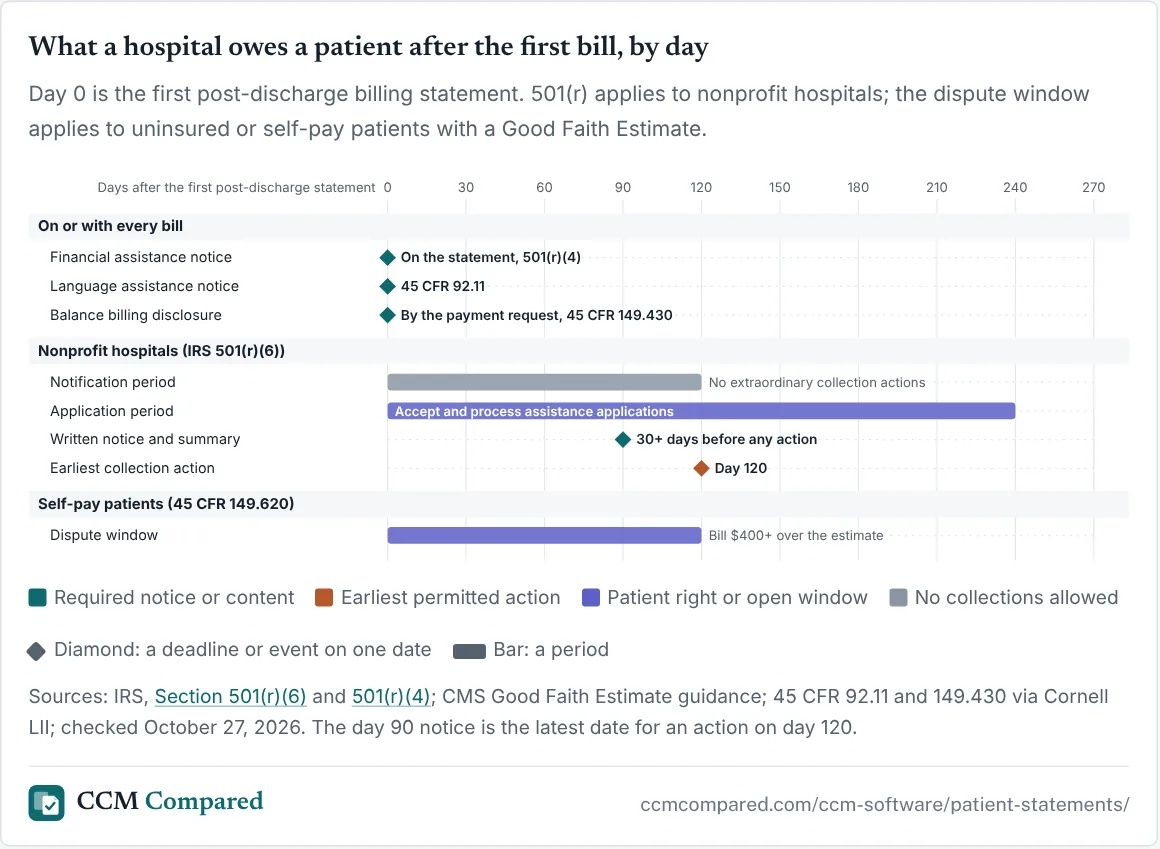
Statement rules aren’t about layout. They’re about which notices ride along with the bill, and how long you wait before collections. Your platform has to apply them per patient.
Day 0 is the first post-discharge billing statement. 501(r) applies to nonprofit hospitals; the dispute window applies to uninsured or self-pay patients with a Good Faith Estimate.
Sources: IRS, Section 501(r)(6) and 501(r)(4); CMS Good Faith Estimate guidance; 45 CFR 92.11 and 149.430 via Cornell LII; checked October 27, 2026. The day 90 notice is the latest date for an action on day 120.
Nonprofit hospitals: the 501(r) notices
Every billing statement needs a conspicuous notice that financial assistance exists. It must give the phone number of the office that helps and the direct web address of your financial assistance policy.
Before any extraordinary collection action, you send a written notice at least 30 days ahead with a plain language summary of the policy, and try to tell the patient orally too. The summary has set contents: eligibility, how to apply, where to get free copies, and a statement that eligible patients can’t be charged more than amounts generally billed.
Translate it for any limited English group that’s the lesser of 1,000 people or 5% of your community. That’s a template and data job, not a print job.
The No Surprises Act notice
You owe patients a one-page, double-sided notice of their balance billing protections, in at least 12-point type. It’s due no later than the moment you ask the patient for payment, in person, by mail or by email as they choose. Hackensack Meridian reported sending its rights letter with the first statement in 2022.
Section 1557 language notices
Billing, collections and Good Faith Estimates are on the list of communications that must carry the notice of free language help. It goes out in English and at least the 15 languages most spoken by people with limited English in your state, unless you’ve recorded the patient’s language or they’ve opted out for the year.
Price transparency is a website job
The hospital price transparency rule asks for at least 300 shoppable services online, or a free price estimator tool, refreshed yearly (45 CFR 180.60). It doesn’t change your statements. But the estimate data behind it often feeds your Good Faith Estimates.
Good Faith Estimates for self-pay patients
Uninsured and self-pay patients get a written estimate before scheduled care. The clock runs in business days from scheduling, so the scheduling system has to trigger it.
| When the service is scheduled | Estimate due | Rule |
|---|---|---|
| 3 to 9 business days ahead | Within 1 business day of scheduling | 45 CFR 149.610(b)(1)(vi)(A) |
| 10 or more business days ahead | Within 3 business days of scheduling | 149.610(b)(1)(vi)(B) |
| Patient asks for one | Within 3 business days of the request | 149.610(b)(1)(vi)(C) |
| Scope or providers change | New estimate at least 1 business day before care | 149.610(b)(1)(vii) |
The estimate lists each item and service by provider, with diagnosis and service codes, expected charges, NPI and tax ID. It needs set disclaimers, including the patient’s right to dispute a bill that runs $400 or more over the estimate. You keep it in the medical record and provide copies for 6 years.
If one provider convenes care with others, it has to ask them for their items within 1 business day of scheduling. That’s the hard part, and it lives in scheduling data. Check what your EHR or revenue cycle vendor already offers before you scope estimates into a CCM project.
Patient statement and revenue cycle specialists
For statements alone, these are where most health systems land. KLAS’s 2025 patient financial engagement report calls it a maturing, well-performing market. Scores below are KLAS’s, out of 100.
Your EHR’s own billing tools
Best for Epic health systems that want statements, MyChart billing and payment plans in one place
- 95.4Epic, KLAS 2025, 18 orgs
- Not rankedBest in KLAS 2025
Epic scored highest of any patient financial engagement product KLAS measured in 2025, praised for a unified experience driven by integration. You’ll still need someone to print and mail. At Hackensack Meridian, for example, Epic sends billing files to a statement vendor that formats them into branded layouts.
Watch out: KLAS respondents flag complexity and training as ongoing challenges.
RevSpring
Best for health systems that want statements, digital outreach and payments run as a service
- 90.3KLAS 2025, 20 orgs
- Best in KLASPatient financial engagement 2025
- 1B+printed items a year, RevSpring says
In March 2026, Southeast Georgia Health System moved its patient statements to RevSpring, adding text and email statements next to paper. Frazier Healthcare bought RevSpring in 2024, and in 2025 RevSpring announced a deal to acquire Kyruus Health, a provider data, search and scheduling company.
Watch out: it’s growing by acquisition, so ask how the Kyruus scheduling tools will connect to your statements and when.
Waystar or Cedar
Best for teams that want billing and payment tied tightly to the EHR portal
- 88.8Waystar, KLAS 2025, 15 orgs
- 89.2Cedar, KLAS 2025, 10 orgs
Waystar added Patientco’s patient communication and payment software through an acquisition announced in 2021. Cedar runs inside Epic at Novant Health across both hospital and physician billing. KLAS credits both Waystar and Flywire (88.4, 16 orgs) with transparent pricing.
Watch out: KLAS found Cedar clients least satisfied with its effect on cost to collect, and says Waystar could improve its relationships.
Two more names come up often. Inovalon announced its Patient Statement Management tool on the PointClickCare Marketplace in 2025 for long-term and post-acute providers. InstaMed, acquired by JPMorgan Chase in 2019, is mainly a payments platform. Experian Health also sells statement services; ask it for health system references.
SmartCOMM alternatives for providers: who has provider proof
Most enterprise CCM vendors’ public healthcare record is with health plans, not hospitals. Read across a row to see what’s on record outside vendor websites, and how old it is. For payer work, see our CCM for healthcare payers guide.
Dates are when it was announced or reported. SmartCOMM shown for reference. As of October 27, 2026.
| Vendor | Named health system customer | Route to providers | EHR link | Statement rules | Source type |
|---|---|---|---|---|---|
| Nordis Expresso | Hackensack Meridian Health: 12 hospitals, about 1.8M statements and letters planned for 2022 1 | Meduit, a revenue cycle firm sending about 2M statements and letters a month 2 | Epic sends billing files for formatting into branded layouts 1 | No Surprises Act rights letter with the first statement 1 | Trade press and press releases |
| Quadient | Two of the five largest U.S. healthcare institutions; not stated whether providers or payers 3 | Premier group purchasing deal for Impress, pitched for patient financial statements 4 | No public record found | No public record found | Trade press |
| OpenText Exstream | Ask for named health system references | No public record found | Ask for an Epic or Oracle Health billing file demo | No public record found | Vendor pages only |
| Messagepoint, Doxim | Ask: public healthcare proof is with health plans or unnamed | No public record found | No public record found | No public record found | Vendor pages and payer press releases |
| SmartCOMMreference | No public record found | No public record found | No public record found | No public record found | Vendor pages only |
The thin record is the point. If a CCM vendor pitches you on statements, make two named health system references a condition of the shortlist.
Nordis Expresso
Best for health systems and revenue cycle firms that want CCM template control on a hosted statement service
- 12Hackensack Meridian hospitals, 2022
- ~1.8Mstatements and letters planned, 2022
Hackensack Meridian replaced a separate statement vendor and payment vendor with Nordis’s cloud CCM and TD Bank’s online payments. Statements carry comment codes from Epic that explain why a balance is owed, and an image of every statement is attached to the patient account. The health system reported higher self-pay collections and fewer calls, without published percentages.
Watch out: its public health system record dates from 2021 and 2022, and it has no review base in our benchmark, so ask for current references.
Best for health systems with a health plan arm, or any group standardizing every patient and member communication
- 4.8 ★130 Gartner ratings (Oct 2026)
- ~€4.5MU.S. healthcare contracts, 2024, Quadient says
In 2024 Quadient announced multi-year Inspire and Impress contracts with U.S. healthcare organizations that wanted to consolidate several separate platforms. Earlier, Premier, an alliance of roughly 4,000 U.S. hospitals, signed a group agreement for Impress, which Quadient pitches for patient financial statements. Ratings aren’t healthcare-specific; every number is in our CCM benchmark.
Watch out: none of its public healthcare deals is clearly a provider statement program, so ask for one.
Weighing OpenText Exstream or Messagepoint? Both rate 4.4 on Gartner Peer Insights (76 and 69 ratings, October 2026), and Messagepoint’s public healthcare proof is with health plans, mostly Medicare Advantage (see our payer guide). Ask either for a demo built on your own Epic or Oracle Health billing file.
Running SmartCOMM for patient communications today?
If your SmartCOMM or SmartIQ contract covers patient billing letters, statements or intake, your renewal is the moment to set exit terms. Ownership is changing: in August 2025 Cinven announced a majority stake in Smart Communications, subject to regulatory approvals.
- Find your notice date in the order form and plan back from it. Our SmartCOMM contract renewal plan has the dated steps.
- Confirm what’s in scope: which billing, statement and intake templates the contract covers, and who maintains the EHR feed.
- Get export rights in writing: templates, rules, shared content, and the archive of sent statements with retention dates intact.
- Ask for transition access so you can run old and new side by side through one full 120-day notification cycle.
- Price a short extension sized to a migration, not a multi-year term.
Then compare your options in SmartCOMM alternatives and plan the move with our guide to migrating off SmartCOMM.
What to put in your RFP
These lines come from the rules above. Add them to our CCM RFP template, whether you’re asking a specialist or a CCM vendor.
- A live demo on your own EHR billing file, including comment codes that explain balances.
- Rule-driven inserts: the 501(r) assistance notice, the balance billing disclosure and the Section 1557 language notice, by facility and state.
- Collections hold logic that blocks extraordinary collection actions before day 120 and proves the 30-day notice went out.
- Language rules for the plain language summary and statements, by community threshold and patient preference.
- Good Faith Estimate output triggered from scheduling, with timestamps and copies retrievable for 6 years.
- Accessible statements for patients who need them; see our accessible communications guide.
- An archive of each statement as sent, searchable by account and date.
- Two health system references of your size you can call without the vendor on the line.
Score the answers with our CCM vendor scorecard.
On the health plan side? See health plan enrollment and onboarding.
Get a vendor shortlist for your requirements
Tell us what you run today and what you need, and we’ll suggest the two or three platforms that fit, and why.
We reply through LinkedIn and only share your details with a vendor if you ask us to.
Frequently asked questions
What is patient statement software?
Software that turns billing data from your EHR or patient accounting system into patient statements, then delivers them by mail, email, text and portal and takes payment. Health systems usually buy it from a patient financial engagement vendor or use their EHR’s own tools.
Do hospitals need a CCM platform for patient statements?
Usually not. Statements alone are well served by EHR billing tools and statement specialists. A CCM platform earns its place when you want one governed template library for statements, clinical letters, plan documents and notices, or you run several billing systems.
When must a provider give a Good Faith Estimate to a self-pay patient?
Within 1 business day of scheduling when the service is 3 to 9 business days away, within 3 business days when it’s 10 or more business days away, and within 3 business days of a request (45 CFR 149.610(b)(1)(vi)). It must be written, on paper or electronically, kept with the medical record, and copies must be available for 6 years.
What must a nonprofit hospital put on its billing statements?
A conspicuous written notice that financial assistance is available, with the phone number of the office that can help and the direct URL of the financial assistance policy, under IRS 501(r)(4). Extraordinary collection actions must wait at least 120 days after the first post-discharge statement.
Is CCM the same as chronic care management?
No. In healthcare, CCM often means Chronic Care Management, a Medicare care-coordination program. This page is about customer communications management: software that produces patient statements, letters and notices.
Charts from this guide
Free to share with a link back to this page. Tap a chart for the full-size image.
Sources
- eCFR: 45 CFR 149.610 (Good Faith Estimates for uninsured or self-pay individuals)
- CMS: Good Faith Estimate and patient-provider dispute resolution for uninsured or self-pay individuals, December 2021
- eCFR via Cornell LII: 45 CFR 149.430 (disclosure of balance billing protections)
- IRS: Financial assistance policy and emergency medical care policy, Section 501(r)(4)
- IRS: Billing and collections, Section 501(r)(6)
- eCFR via Cornell LII: 45 CFR 92.11 (notice of availability of language assistance)
- eCFR via Cornell LII: 45 CFR 180.60 (hospital price transparency, shoppable services)
- KLAS Research: Patient Financial Engagement 2025, Best in KLAS ranking
- KLAS Research: Patient Financial Engagement 2025 report, December 2025
- Becker’s Hospital Review: Georgia health system launches new digital patient billing system, March 2026
- Fierce Healthcare: Frazier Healthcare Partners acquires RevSpring, March 2024
- Healthcare IT Today (press release): RevSpring to acquire Kyruus Health, October 2025
- Becker’s Hospital Review: Waystar to acquire Patientco, July 2021
- Becker’s Hospital Review: Novant Health integrates Cedar into its Epic EHR, August 2022
- Business Wire (press release): Inovalon patient statement and payment tools on PointClickCare Marketplace, February 2025
- MedCity News: JPMorgan Chase acquires InstaMed, May 2019
- Healthcare IT News: Patient communications IT increases self-pay collections for Hackensack Meridian, September 2022
- Business Wire (press release): Hackensack Meridian Health, TD Bank and Nordis Technologies, June 2022
- accountsrecovery.net (press release): Meduit taps Nordis Technologies, March 2021
- DOCUMENT Strategy Media: Quadient awarded mailing services agreement with Premier, September 2020
- KMWorld: Healthcare giants partner with Quadient, May 2024
- Gartner Peer Insights: Customer Communications Management Software market
- CFOtech UK: Cinven acquires majority stake in Smart Communications, August 2025
CCM Compared is independent and not affiliated with Smart Communications or any vendor named here. Product names are trademarks of their owners and are used to identify products only. See our methodology and disclosure. Spotted an error? Request a correction.